Government institutions in the village” means the public bodies and offices that work in a village to provide services and run local administration.
It usually includes the
Gram Panchayat
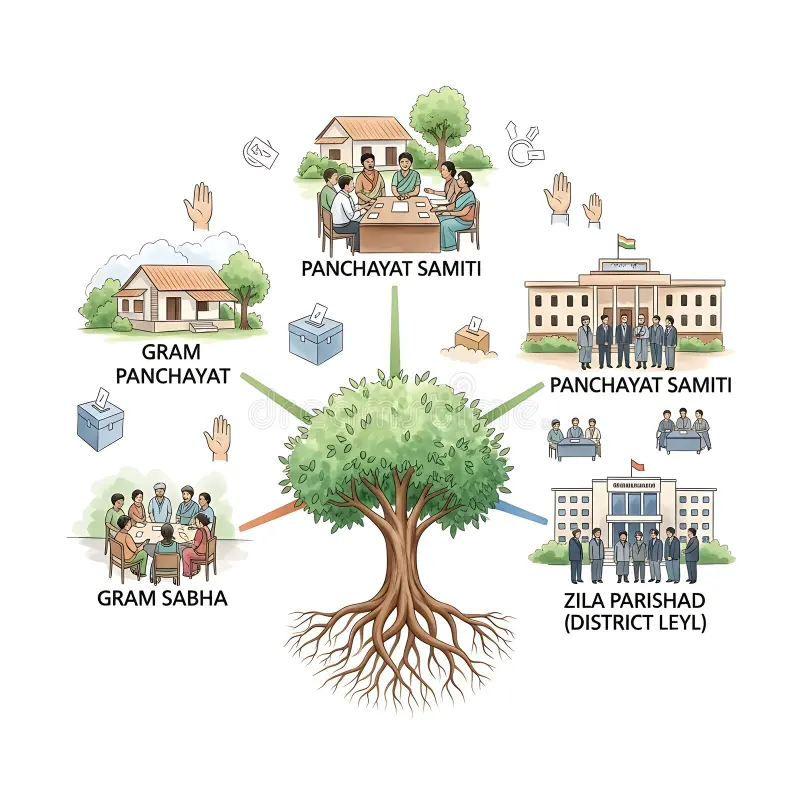 A Gram Panchayat is the basic unit of local self‑government at the village level in India.
It is an elected body that governs a village or a group of villages and forms the lowest tier of the Panchayati Raj system, along with Panchayat Samiti and Zila Parishad.
The Gram Panchayat is headed by a Sarpanch (elected president), supported by ward members and a secretary, and is responsible for local works such as sanitation, roads, drinking water, schools, and welfare schemes.
Read more
, village administration office, Public Distribution System (Ration Shop), school, hospital, police station, forest office, and other departments that serve the public.
In simple words, these are the government-run places that help manage village life, development, safety, education, health, and natural resources.
A Gram Panchayat is the basic unit of local self‑government at the village level in India.
It is an elected body that governs a village or a group of villages and forms the lowest tier of the Panchayati Raj system, along with Panchayat Samiti and Zila Parishad.
The Gram Panchayat is headed by a Sarpanch (elected president), supported by ward members and a secretary, and is responsible for local works such as sanitation, roads, drinking water, schools, and welfare schemes.
Read more
, village administration office, Public Distribution System (Ration Shop), school, hospital, police station, forest office, and other departments that serve the public.
In simple words, these are the government-run places that help manage village life, development, safety, education, health, and natural resources.
A private institution in the village is an organization or service centre located in a village that is owned and run by private individuals, families, trusts, or companies, not by the government.
It usually: provides services such as education (private school/creche), tuition centre, clinic, tuition/coaching centre, small hospital, library, or recreational facility.it self‑financed through fees, donations, or private investment.
operates under its own rules, within general laws, but not directly controlled by the government.